|
|
The information contained herein is of a general character and will be
supplemented upon requested by specific instructions applying to the particular
type of rotary pump being operated. It is requested that these instructions
be placed in the hands of those directly charged with the installation and
operation of the equipment. Satisfactory service can be realized only upon
strict adherence of these instructions
Inspect and check shipping manifest immediately on receipt of shipment
and report any damage or shortage to the company.
The pumps should be installed in alight, clean, dry location and so place
that it is easily accessible for inspection. Suction piping should be full
size, short and direct. Motor driven units should not be located in damp
or moist places unless provision has been made for this condition.
The foundation should afford permanent rigid supported for the entire
unit.
Concrete foundation built up from solid ground will prove most satisfactory.
Ample allowance should be provided for grout in building the foundation.
Foundation bolts of the specified size should be accurately located according
to drawings when the concrete is poured.
When a unit is mounted on steel work or other structure, it should be set
directly over, or as close as possible to the supporting beams or walls,
and should be so supported that the base plate cannot be distorted
by yielding or springing of the structure.
Correct alignment is absolutely essential for successful operation. A
flexible coupling will not compensate for slight changes in alignments which
may occur during normal operation.
Every unit assembled at work is accurately aligned by placing the base
plate on surface plate and then leveling the machined pads. Shims are inserted
under the feet of the pump and driver when necessary to obtain perfect alignment.
However, all base plates are elastics and for this reason we cannot assume
responsibility for the proper mechanical operation of a unity unless the
shop alignment is reproduced when the unit is erected on its foundation.
Pumps are usually shipped on their base plates and it is seldom necessary
to remove the pump and driver from the base plate while leveling. The pumping
unit should be placed on the foundation supported by wedges place near the
foundation bolts. Remove the paint from the projections of the base
plate pads upon which the pump feet are supported. Place a spirit level
on these pads and adjust the wedges under the base plate to boring the pump
to the shaft level.
The alignment is then to be checked and corrected so as to bring the driver
half coupling in perfect alignment with the pump half coupling. The checking
of alignment can be accomplished by the use of a straight-edge across the
top and sides of the coupling.
If the coupling’s flanges are not perfectly true or not of the same diameter,
check the alignment by revolving coupling and checking at each quarter turn.
If any variation is found, proper allowance must be made in alignment the
unit. The clearances between the coupling halves should be set so that they
cannot strike, rub or exert end thrust on either pump or driver.
Alignment must be checked after the pump has been completely piped up
because pumps are frequently sprung and pulled out of position by drawing
up flange bolts when the flanges are not squired up before tightening .Particular
care must be taken that the suction and discharge piping is properly supported
to prevent a strain or pull on the pump. Pipe strain are a common cause
of misalignment, hot bearings, wear and vibration.
The base plate should be grouted in before the piping connections are
made. The usual mixture for grout is : one part cement and two parts sand
with sufficient water cause the mixture to flow freely. The grout should
be worked in under the base plate so as to support it fully throughout its
whole area.
Experience has proved that a faulty suction line is responsible for trouble
with rotary pumps. Suction piping should never be less diameter than the
full size of the pumps suction opening. It should be as short and direct
as possible and thoroughly clean. It should be uniformly graded up form
the source of the supply to the pump. When drawing liquid over long distances
or on high suction lifts or when handling thick, viscous liquids, the diameter
of the suction pipe should be greater then the opening in the pump to convey
the liquid with minimum pipe friction loss.
Rotary pumps have excellent suction qualities but cannot be expected to
do the impossible. Remember that atmospheric pressure (14.71 1bs.Per sq
.inch absolute) is shall that forces liquid into a pump. If the static suction
lift plus suction pipe friction is equal to or greater than the equivalent
of atmospheric pressure, the pump will not fill, resulting or entire loss
of capacity.
When pumping highly volatile liquid such as butane, propane, hot oils, etc.
there must be sufficient static head on the suction in addition to the vapour
pressure to prevent vaporization of the liquid within the pump. Rapid wear
or Brazing will result if these pumps are allowed to run dry.
The suction line should be perfectly air-tight. A leak will result in
reduced or entire loss of capacity. A strainer is recommended if the liquid
contains foreign material. Abrasives in the liquid will cause rapid wear.
The strainer should have a net area of from three to four times the suction
pipe area and should permit easy cleaning. Always carry the discharge up
through a riser approximately five times the diameter. This prevents gas
or air pockets in the pump and will act as a seal high vacuum service. A
valve on the top of the riser may be used as a vent when starting the pump.
To protect the pump against excessive pressures caused by increased pipe
friction in cold weather or accidental closing of valve should be set slightly
higher than maximum pump discharge pressure but not more then 10%
Normally pumps are provided with neoprene rubber oil seals.
When gland packing is provided, do not tighten the glands too tightly as
a slight leakage will help to lubricate the packing.
Before starting up for first time, prime up the wet gears for effective
suction.
These pumps are run and tested on oil. Unless specified on the order, the
oil is left pump to protect the internal mechanism against corrosion. if
this oil is detrimental to the system, it will be necessary to detrimental
to the pump, clean all parts thoroughly and fill the pump with the liquid
to be pumped.
Never start or run the pump dry. This will invariable cause galling, seizing
or destructive wear between the rotors, end plates and casing.
Direction of rotation is marked with an arrow on the pump.
When the direction of rotation is to be reversed, fix the back cover after
rotating the same 180 angle. The bolts should be secured tight in the original
position so that there is no leakage.
Before starting prime the pump and then check the prime mover for correct
rotation. Check pressure or vacuum on the inlet and outlet side to
be sure that the pump will deliver full capacity without overloading the
driver.
It is advisable to start operation at a reduced load gradually increasing
to maximum service condition.
External bearing pumps require occasional lubrication of soft grease in
the bearing. If no grease fittings are furnished on internal bearing pump,
no attention for lubrication is necessary.
-
Alignment of the pump and motor should be checked.
-
Suction line should be checked for no air leakage and jamming of
the dirt in filter.
-
If there is a pressure drop, the relief valve should be further screwed
in till desired pressure is achieved. If this does not give any
result, then there should be a considerate wear in the plates,
which should be replaced.
-
Leakage, if any, on end covers should be eliminated by tightening
bolts.
-
If a pressure drop is too much, the gears or the wear plates should
be changed as the case may be due to excess wear on them.
-
Oil seal should be replaced if there is leakage from the drive end.
-
On dismantling, if the body shows wear, then it should be sent back
to us for placement. This will be a very long run only.
-
Bearings, if found worn out, should be replaced.
IMPORTANT - Top
-
If the pump gets jammed in running position, then loosen all the
bolts by half a turn (this will also be in the case of pumps with bush
bearings) and try to rotate the pump shaft with pipe spanner. if it
rotate then start pump and allow it to run smoothly and lighten the
bolts slowly till there is no jamming.
-
if the rotor does not rotate, then dismantling is necessary.
-
Where the pump is excessively heated in the initial running, and
jamming is caused, allow it to cool down to the temperature till the
jamming is eliminated.
-
At the time of commissioning, under no circumstance the pump should
be dismantled due to any fault whatsoever without consulting the manufacturers.
-
At the commissioning stage, if the shaft is found tight, try to rotate
the shaft with the help of pipe wrench. if it rotates with the pipe
wrench, then tightness should be considered as normal and the pump can
be started without any trouble.
-
Unbolt side covers and push out assembly of rotors and bushes making
note of packing on either side.
-
Slide out the bushes form shafts and check for face wear. If excessive
wear is there, replace them and If minor wear is there, have a fine
machine cut on the face such that both bushes on either side are exactly
of same width.
-
Number of packing should be reduced corresponding to the reduction
in bush width but minimum one packing should be there on either side.
-
Remove all the burrs in body bore, on body faces as well as on rotors.
Insert the rotors first in the body and then fit the bushes on either
end and check for free rotation.
-
If seal is damaged, take out circlip and seal, replace with new seal
and fit back in the cover.
-
Put appropriate packing with grease taking care that there is no
overlapping on bush faces and then fit the covers with bolts.
-
Free rotating of the shaft should be checked with a small pipe
wrench. if shaft is found tight, loosen cover bolts by quarter turn
and start the pump. When it runs smoothly tighten the bolts equally
and slowly. if seizure occurs, add one more packing.
-
In case of any ovality found in bush bore, it should be replaced.
-
If excessive wear is found on gear teeth, complete set is to be replaced.
-
Pumps are fitted with 'O' rings. In case of any wear on bush face
in pumps, it should be replace
-
Minor scoring in body bore will not affect pumps' performance to
great extent but if heavy scoring is found, body should be replaced.
-
Unbolt both side covers making note of packing on either side.
-
Heavier pumps are provided with jacking arrangement to take out covers.
Threaded holes are provided on covers. Insert suitable bolts and jack
up the cover.
-
Push out the assembly of rotors, wear plates and bearings such that
wear plates of opposite side come out of the body, By means of
pullers, take out the bearings and wear plates and push the remaining
assembly out in the opposite direction. Take out the bearing and
wear plates from the other side also by means of pullers.
-
Check the wear on wear plates. if excessive wear is there, replace
the complete set of wear plates. In case of minor wear , take
a fine machine cut on the face such that the width of top and
bottom wear plates is equal.
-
Check the wear on gears and shaft. If minor wear is observed on face
of gears grind the faces (in case of hardened of hardened gears)
or take a fine machine on the face of soft gears such that driver and
driver gears match perfectly well with the same face width. Remove all
burrs from body bore, body face as well as on rotors and wear plates.
-
Insert the rotors first in the body and then wear plates on both
sides. Now fit the bearings in each wear plate. Keep a watch on free
rotation of shaft with the help of a pipes wrench.
-
Reduce the packing corresponding to the reduction in width of wear
plates and gears. Place the packing on body face with grease such that
there is no overlapping on wear plates.
-
If seals are damaged, take out circlip and seals and fit new seals
in the cover.
-
Now fit front and back covers and bolt them. if dowel pins are provided
covers should be first located with dowel pins and then they should
be bolted.
-
In case of excessive scoring in pump body, it should be replaced.
-
If pump is not rotating freely, loosen cover bolts slightly. Now
start the pump and let it run for some time, then tighten all bolts
equally. In case of seizure and one more packing.
-
If the pumps is having steam jacket, then before taking out cover
remove jacket coupling and plugs from both covers.
| 1. |
Neoprene Oil Seals |
2 No |
| 2. |
Relief Valve Spring |
1 No |
| 3. |
Packing Set |
1 Set |
| 4. |
Rubber Spaider of Coupling |
1 No |
| 1 |
Bush Bearing
|
1 Set |
| 2 |
Ball Bearing |
1 Set |
| 3 |
Wear Plates |
1 Set |
| 4 |
Gear Set with Shafts |
1 Set |
-
In case of pumps provided with Mech/seal instead of oil seals, procure
1 no. Mech/seal
-
While floating your enquiries for spares of "ALFA" Rotary Gear Pumps,
please furnish the following details:
-
Nameplate details / Pumps Serial Number.
-
Purchase order number and data
| Sr. No |
Fault |
Cause |
Action |
| I. |
a) Pump does not prime |
1.Rotation wrong connection on motor. |
Check rotation .If necessary changes |
| |
|
2. Pump is dry |
Fill pump initially with oil |
| |
|
3. Suction line is not tight |
Tighten all bolts and nuts on suction side. If necessary, pressure
test suction line. Attach vacuum gauge which should show approximately
20 inc. Hg Vacuum at closed suction valve. |
| |
|
Relief Valve not tight. Damaged valve joint Foreign body between
valve seat and valve |
Remove valve and check seal. If necessary grind in. Check joint
between suction and discharge opening in the pump. if necessary
replace joint. Remove foreign body. Incase of damage to valve seat,
grind in Tighten bolts of cover |
| I. |
b) In the case of working against closed discharged line |
1.Evacuated air cannot pass through the pressurized oil column
and streams back into the suction line |
Arrange deaeration cock on discharge side of pump. When pump
is started, open this cock until all air is exhausted and then close.
In the suction line, when switching off pump, remains full. |
| II. |
Loss of output |
1.Speed too slow |
Check speed by means of a tacho meter. Check frequency and voltage
motor name plate. Check pump as in the case of overload, speed can
be dropped. Check star-delta and compare with voltage |
| |
|
2.Relief valve opens too soon |
Remove valve cover and adjusting screw. if spring is fatigued,
replace. Take care when adjusting that the pressure rise with closed
discharged valve does not overload, speed can be dropped. Check
star-delta and compare with voltage. |
| |
|
3.Loss in output due to air in stuffing box |
See fault 1,paragraph 3 |
| |
|
4.Suction line friction too great |
Fit vacuum gauge and check suction lift which should not be
more than 5-6 MLC. |
| |
|
A) Suction pipe too small |
In the case of items (a), (b), & (d) only, a large suction line
or a reduction in length can help. |
| |
|
B) Suction line too long |
In case of (C) clean the filter element. |
| |
|
C) Suction filter blocked |
|
| |
|
D) Viscosity too high. |
|
| III |
Pump is noisy |
1.Badly aligned coupling |
Disconnect pump for motor and align coupling |
| |
A) Mechanical Noise |
2. Spindle not running |
Strip motor and remove main spindle (as operation that should
be carried out only by an expert.) Test with clock gauge between
centers. |
| |
|
3.Gear flanks are damaged |
Remove gears and correct damaged flanks by foreign bodies with
oil stone Finally grind by hand |
| |
|
4.Delivery against low |
Load gear flanks by closing discharge, valve giving approximately
15-20 psi. Noise will be eliminated |
| |
B) Hydraulic or Pneumatic |
5. The pumped medium contains air |
Determine whether air is drawn through leak (see also Fault
II paragraph 2&3) or whether return line is unsuitable in case of
a circulating pump. In such a case it is also necessary that the
return pipe terminates below liquid level. |
| |
|
6.Cavitations due to |
|
| |
|
A) Too high suction lift. |
a) Reduce the suction lift. |
| |
|
B) Excessive speed in the case of very viscous Liquids. |
b) Reduce speed. Only a low vacuum is permissible. |
| |
|
C) Pumping of liquids which are highly volatile like petrol,
solvents ect. |
Under certain circumstances liquid may require pressurization,
depending on its vapour pressure |
| iv |
Motor is heating up |
Wrong connection of motors or only two Phases |
Connecting motor according to name plate and check voltages
in all three phases |
| |
|
3.Wrong frequency |
Check frequency on name plate. |
| |
|
4. Pump, seizing |
Disconnect pressure gauge on the discharge branch and check
whether delivery pressure is in accordance with the name plate of
the pump. |
| |
|
5.Delivery pressure too high |
Connect pressure gauge on the discharge branch and check whether
delivery pressure is in accordance with the name plate of the pump.
|
| |
|
6.Viscosity too high |
Check viscosity at pumping temperature and compare with name
plate of the pump. |
| |
|
7.Mis-alignment |
Re-align coupling |
| v |
Fluctuating delivery |
1. Frothing medium |
Avoid air entry in the oil (see that in the case of circulating
pumps, the return line ends well below the oil level.) |
| VI |
Pump Seized |
1. Excessive pressure due to wrongly adjusted relief valve |
Check relief valve pressure at close discharge valve, re-adjust
relief valve, so that it opens approximately at 10% above working
pressure. |
| |
|
2.Foreign body in pumped medium |
Dismantle pump. Remove foreign body, Smoother seized area with
oil stone, if necessary, fit new bearings and provide suction filter. |
| |
|
3.Dry running |
Remove seized area as above. Fill with oil and wet rotors before
starting up. Under certain circumstances check deaeration. (See
suction1, paragraph 2. |
| |
|
4.Insuffcient lubricating quality of pumped medium |
Check whether pumped medium has lost its lubricating properties
due to elevated temperature.
If a pump has seized, gear and bearings should be dismantled. All
seized areas to be smothered with oil stone. The bearing should
be scraped and casting bores ground if necessary. Reassemble the
pump and put it in operation initially at low pressure. |
| VII |
Relief valve chattering |
1.Valve is jammed. |
Fit new spring, check valve for easy movement in the valve seat. |
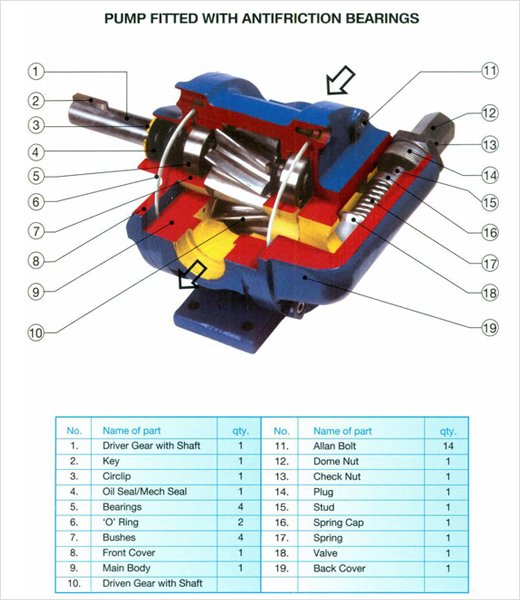
PUMP FITTED WITH ANTIFRICTION BEARINGS -
Top
| No. |
Name of part |
qty. |
No |
Name of the part |
qty. |
| 1. |
Driver Gear with Shaft |
1 |
11. |
Allan Bolt |
14 |
| 2. |
Key |
1 |
12. |
Dome Nut |
1 |
| 3. |
Circlip |
1 |
13. |
Check Nut |
1 |
| 4. |
Oil Seal/Mech Seal |
1 |
14. |
Plug |
1 |
| 5. |
Bearings |
4 |
15. |
Stud |
1 |
| 6. |
'O' Ring |
2 |
16. |
Spring Cap |
1 |
| 7. |
Bushes |
4 |
17. |
Spring |
|
| 8. |
Front Cover |
1 |
18. |
Valve |
1 |
| 9. |
Main Body |
1 |
19. |
Back Cover |
1 |
| 10. |
Driven Gear with Shaft |
|
|
|
|
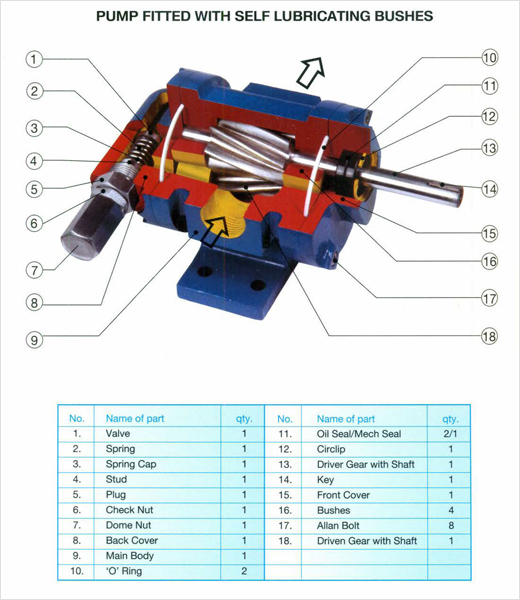
PUMP FITTED WITH ANTIFRICTION BEARINGS -
Top
| No. |
Name of part |
qty. |
No |
Name of the part |
qty. |
| 1. |
Valve |
1 |
11. |
Oil Seal/Mech Seal |
2/1 |
| 2. |
Spring |
1 |
12. |
Circlip |
1 |
| 3. |
Spring Cap |
1 |
13. |
Driver Gear with Shaft |
1 |
| 4. |
Stud |
1 |
14. |
key |
1 |
| 5. |
Plug |
1 |
15. |
Front Cover |
1 |
| 6. |
Check Nut |
1 |
16. |
Bushes |
4 |
| 7. |
Dome Nut |
1 |
17. |
Allan Bolt |
8 |
| 8. |
Back Cover |
1 |
18. |
Driven Gear with Shaft |
1 |
| 9. |
Main Body |
1 |
|
|
|
| 10. |
'O' Ring |
2. |
|
|
|
|